
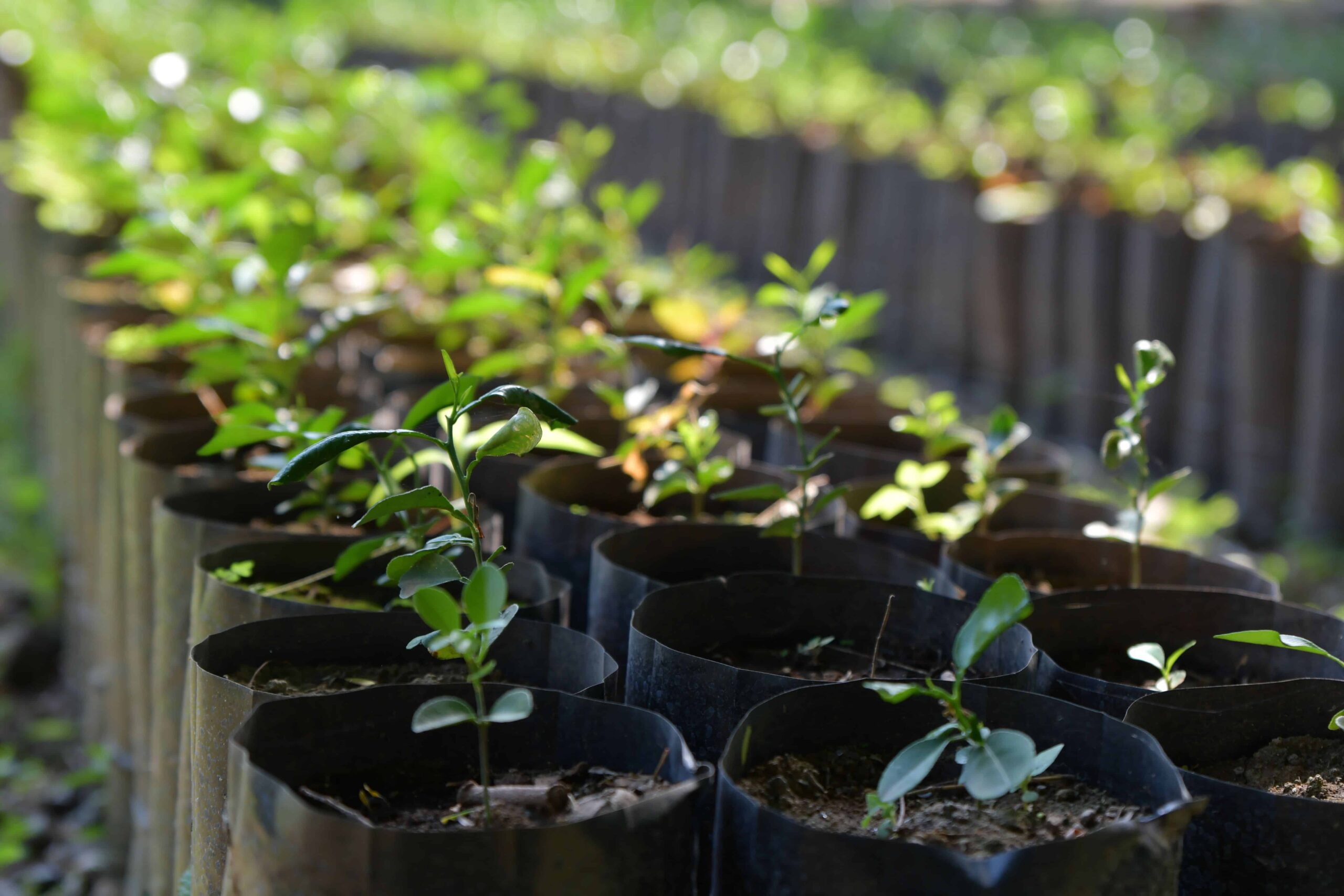
Planting a tree seedling is one of the highest-leverage things you can do in a landscape. A $5 bare-root sapling planted correctly in the right location will outlast almost everything else you put in the ground. The gap between success and failure usually comes down to three decisions: species selection, site preparation, and early care.
Here’s what you need to know before you plant.
What tree seedlings actually are
Seedlings are young trees grown from seed, typically between 6 and 24 inches tall when sold. They’re different from container-grown nursery stock (which is older, heavier, and more expensive) and from saplings (a loose term for anything older than a seedling but not yet a mature tree).
Bare-root seedlings ship without soil around their roots, in a dormant or semi-dormant state. This makes them affordable, lightweight, and well-suited to large-scale planting. The roots are young and fibrous, which means they establish quickly in a new site when planted correctly.
The trade-off is a tighter planting window. Bare-root stock needs to go in the ground soon after it arrives, before it breaks dormancy. Fall and early spring are the standard planting seasons.
How to choose the right species
The single most important rule: match the tree to the site, not to your preference.
A red maple planted in droughty, sandy soil will struggle year after year. An Eastern redbud planted under utility lines will need constant pruning when it reaches 20 to 30 feet. These problems are avoidable if you account for mature size, moisture tolerance, and light requirements before you plant.
Here are the site questions that matter most:
Moisture: Does the area stay wet after rain, or does it dry out quickly? River birch and bald cypress handle wet feet well. White oak and redbud prefer well-draining soil.
Sun exposure: Full sun means 6 or more hours of direct light daily. Most fast-growing shade trees — red maple, tulip poplar, sycamore — need full sun to grow at the rates you expect. Dogwood and serviceberry are understory trees that perform well in part shade.
Mature size: A tulip poplar reaches 70 to 90 feet. A redbud tops out around 20 to 30 feet. The distance from structures, power lines, and neighboring trees needs to account for the mature spread, not just the planting-day size. Buy for the finished size.
Soil type: Clay soils drain slowly and compact easily. Sandy soils drain too fast and hold fewer nutrients. Native trees adapted to your region’s natural soils will always outperform exotic species trying to grow in conditions they weren’t built for.
Best tree seedlings for common landscape goals
For shade: Red maple, sycamore, and tulip poplar all grow quickly and develop substantial canopies. Red maple tolerates more soil variability than most and colors reliably in fall.
For wildlife habitat: Native oaks are the most valuable trees you can plant for wildlife. A single mature white oak supports several hundred insect species, which in turn support birds and small mammals. Plant oaks where they have room to grow without crowding.
For erosion control and streambanks: River birch, black willow, and sycamore all root aggressively along waterways. Black willow is the fastest-rooting native option for streambank stabilization.
For smaller yards and understory planting: Eastern redbud and flowering dogwood are both under 30 feet at maturity and tolerate part shade. Redbud flowers purple in early spring before leaves emerge, making it one of the best early-season bloomers available in bare-root seedling form. Pair them with perennials at the base — coneflower, salvia, and creeping phlox all do well in the dappled light beneath a redbud canopy.
For privacy rows and windbreaks: Evergreen species like eastern white pine and Virginia pine grow fast, hold their foliage year-round, and create effective screens within 5 to 7 years when planted 8 to 10 feet apart.
Site preparation
Clear competing vegetation from a 3-foot radius around each planting hole. Grass and weeds compete aggressively with young seedlings for water and nutrients. A circle of mulch or ground cloth suppresses competition better than any fertilizer.
Dig the hole twice as wide as the root spread and only as deep as the root length. Planting too deep is the most common seedling failure. The root collar (where the stem meets the root system) should sit at or just above the soil surface.
Loosen the soil at the base of the hole. If the native soil is heavily compacted or clay-heavy, mix in some compost. Don’t create a pure compost pocket, though — roots need to grow into native soil eventually, and a dramatic texture change at the hole’s edge can trap water.
Planting technique for bare-root seedlings
- Keep roots moist from arrival until planting. Wrap in damp burlap or soak briefly in water if planting within 24 hours.
- Trim any broken or circling roots cleanly before planting.
- Hold the seedling at the correct depth and backfill with native soil in layers, firming gently as you go to eliminate air pockets.
- Water thoroughly after planting to settle the soil around the roots.
- Spread 2 to 3 inches of mulch around the base, keeping it away from the stem by a few inches. Mulch against the stem invites rot and rodent damage.
Don’t stake unless the site is extremely windy. Trees that flex slightly in the wind develop stronger trunks than staked trees, which can become dependent on the support.
Watering in the first two years
Year one is the most critical. Seedlings need consistent moisture while their root systems expand. In the absence of rainfall, water once or twice a week for the first growing season. A slow, deep soak is better than a quick surface spray.
Year two, reduce frequency but maintain depth. By the end of year two, most native seedlings have extended their root systems far enough to handle dry spells without intervention.
What to expect from growth rates
Growth rates vary by species, but most seedlings put their energy into roots in year one and above-ground growth in years two and three. A redbud seedling planted at 12 inches might reach 3 to 4 feet by the end of year two. A red maple under good conditions can add 3 to 5 feet of height per year once established.
Evergreen seedlings tend to grow more slowly in the first few years but accelerate once root systems are established.
Don’t measure success by first-year height. A seedling with healthy, well-developed roots will always outperform a fast-growing plant with a weak root system.
Buying in bulk
For restoration projects, large privacy rows, or landowners planting across multiple acres, seedlings bought in bulk reduce cost significantly compared to container-grown stock. Bare-root seedlings ship economically in bundles of 25 to 50 per species, and the per-plant price is a fraction of what you’d pay for established nursery trees.
Consistency matters in large plantings. Ordering from a single source ensures matching species, the same shipping window, and stock that’s been handled uniformly from germination.
FAQ
When is the best time to plant tree seedlings? Fall (after leaf drop) and early spring (before bud break) are both effective. Fall planting lets roots establish before winter without the stress of summer heat. Spring planting gives the tree a full growing season before it faces its first drought.
How far apart should seedlings be spaced? Spacing depends on species and purpose. For shade trees, 20 to 40 feet gives mature canopies room. For privacy rows with evergreens, 6 to 10 feet creates a solid screen within a few years. For wildlife plantings, irregular spacing of 10 to 15 feet is fine.
Do tree seedlings need fertilizer? Usually not in the first year. Fertilizer before roots are established pushes top growth faster than the root system can support it. In year two, a slow-release granular fertilizer in early spring can help, especially in nutrient-poor soils.
How do I protect seedlings from deer? Tree tubes or wire cages around individual seedlings give physical protection. They also create a warmer microclimate that accelerates early growth. For large-scale plantings, perimeter fencing is more practical than protecting individual trees.